
Let’s Get Consensual
The Let’s Get Consensual campaign was developed by the University of Victoria Students’ Society (UVSS) in partnership with the Anti Violence Project (AVP). On our end, we advocate for consent through workshops, education, and events.
From the UVSS website:
Let’s Get Consensual is a student-led movement to end rape culture on post-secondary campuses across BC.
Our mission is to make campuses safer by providing judgment-free consent education and training, and to fight rape culture on campuses. From condoms to consent training, we do this in a number of ways: poster and media campaigns, workshops and training, safer sex supplies, student outreach and engagement, and much more!
Want to learn more? Email us if you’d like to request a consent training workshop on your campus facilitated by OCSU.
The Six Elements of Consent
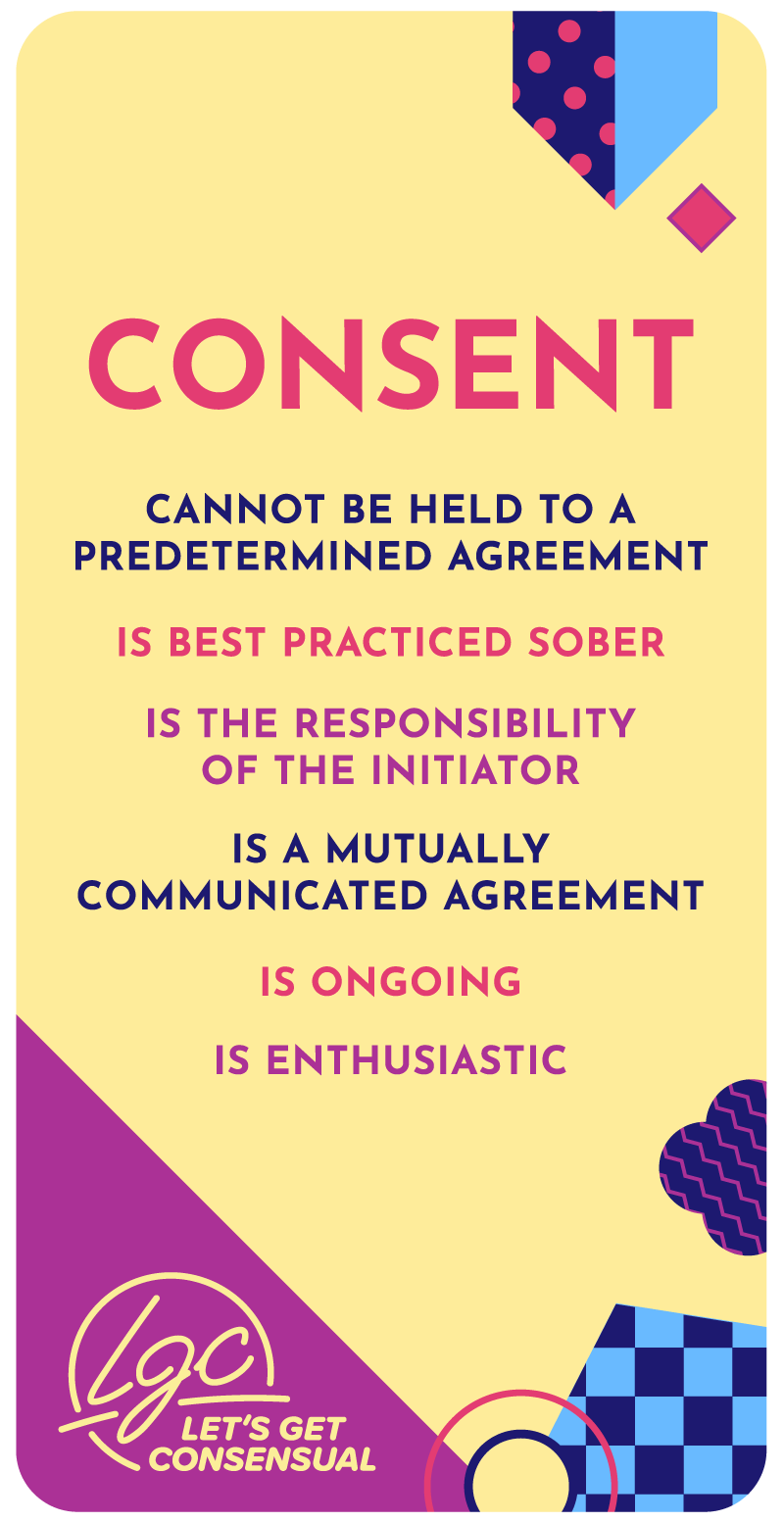
Below are the six elements of consent. Click on the “+” sign to learn more about what each element means and how to apply it IRL.
-
Consent can be withdrawn by either party at any time. It doesn’t matter if they promised their consent, already gave their consent, or have given consent multiple times before. Everyone has the right to change their mind.
-
Both parties need to be in the right headspace in order to consent. Ideally, that means they’re sober. Alcohol, weed, or other drugs can make a person easier to influence or pressure than when they’re sober.
-
The person who is making the request is in charge of securing consent from the other person. They can’t assume consent. They should also make sure that they’re following the six elements of consent, and withdraw their request if needed.
-
When having conversations about consent both parties have to agree on specifically what they consent to or against. This includes aspects of what people are involved, the time of the involvement, and any other details that they agree to.
-
Consent is a continuous agreement, not a one-and-done deal. All parties should check in with one another to make sure everyone is still on board. Remember, consent can be withdrawn at any time — everyone has a right to change their mind.
-
Consent needs to be mutually enthusiastic and/or engaged. That means it’s more than just voluntary — both parties are excited about the agreement, and they aren’t just doing it because they think that they are expected to or required to.
It it’s anything other than a “YES!” it’s a “NO!”
Understanding consent
If you’re struggling with understanding consent and why it matters, the “Tea Consent” video by Emmeline May and Blue Seat Studios is a must-watch.
Resources at Okanagan College
The Okanagan College Students’ Union has partnered with Okanagan College to launch a campaign designed to stimulate awareness and dialogue on campus about the issue of consent and Okanagan College’s sexual violence and sexual misconduct policy and supports. We host events and actions in support of this campaign annually on each campus. Please sign our pledge to get involved, pledges are available in all three offices.
Not sure what consent means and some of the language used with Consent culture? Here is a handy definitions guide.
The resources listed on this page have been sourced from the OC Sexual Violence Support Webpage.
-
Coordinated Support Services supports students who might struggle to navigate the complexities of post-secondary education. They are able to work with the student to gain insight into their struggles and make effective referrals to other OC or community-based support services. If you have experienced sexual violence, the Coordinated Support Services team can help you explore the various support options available and collaboratively work with you to create an empowering plan. This can include different reporting pathways, academic concessions such as assignment extensions and exam re-scheduling, connection to community resources, developing safety strategies, and guidance through college policies.
To get help accessing support and to discuss what options may be available to you, reach out to occares@okanagan.bc.ca or visit us in person at the Student Services Office (S111 at the Kelowna Campus) and ask to speak to someone from CSS.
-
OC Counsellors provide free, confidential, one-on-one counselling support.
Clinical Counsellors provide a safe and confidential space to process your experience with sexual violence while working collaboratively with you to strengthen your ability to cope right here on campus.
Can help make referrals to longer-term counselling options and supports in the community.
To request an appointment or for more information visit the OC Counselling Services webpage.
-
Security can be contacted in urgent or emergency situations. If you feel unsafe on campus, call 911 or Campus Security at:
Kelowna campus: 250-317-2435
Penticton campus: 250-486-3879
Salmon Arm campus: 250-317-2435 (no on-site security)
Vernon campus: 250-307-4574
Campus Security also offers a Safe Walk program should you wish for security to escort you to your vehicle or another location on campus. Visit the Campus Security webpage for more information on this resource and to download the OC Safe app.
Forms
-
Share only the information you choose; no need to identify yourself.
Use this form if you want us to be aware of what happened without seeking immediate support.
Helps the Coordinated Support Services (CSS) team monitor and understand incidents on campus.
While we cannot respond directly to anonymous disclosures, your input helps improve policies and support services.
While this is an anonymous option, if you wish to access support or explore additional disclosure options in the future, you can contact CSS or other trusted resources at any time.
-
Confidentially share your name, contact info, and any details you wish to provide about the incident.
Use this form to connect with CSS, explore your reporting options, and create a personalized support plan. We will contact you to schedule a meeting.
How we can help:
Connect to campus and community resources
Start an official campus investigation
Provide academic concessions
Assist with filing an RCMP report
Community Resources
-
-
-
-
Please note that Victim Services and Violence Against Women Program Directory - Province of British Columbia provides the
most up-to-date contact information for all programs. This information is intended to support institutions in referring
survivors to resources within their community.